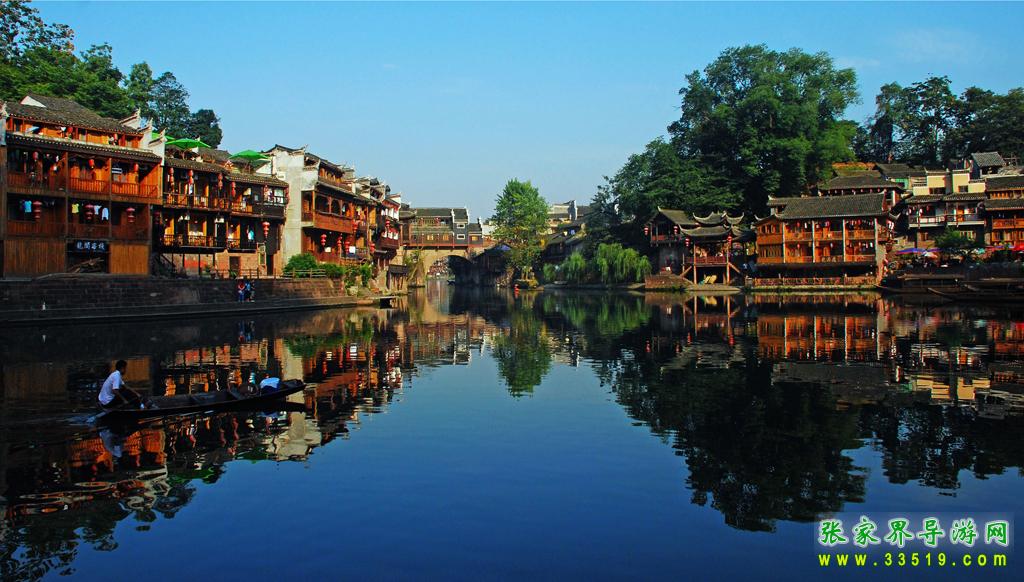
This attraction introduction is compiled from historical materials in the "Zhangjiajie Tour Guide Network" (33519.com · Scenic Spots section). Ticket prices, opening hours, transportation, and contact information mentioned in the text may be outdated. Please refer to the latest official announcements from the scenic area before traveling; some content consists of historical background/cultural introductions and is for reference only.
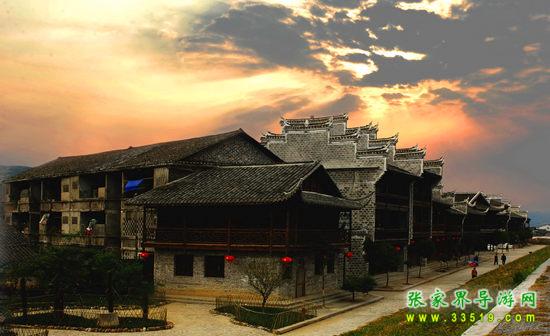
Liye Town is located 124 kilometers south of Longshan County seat. It borders Neixi Township to the north, Zaguo Township to the east, Baojing County to the south, and Xiushan County of Chongqing to the west. During the Republic of China period, it belonged to Sijia Township. In 1950, it was Wujia, Daban, and Zhuoluo Townships of District Five. In 1958, Liye Commune was established, and in 1987 the commune and town were merged into Liye Town. The total area is 165 square kilometers. Among them, there are 447.4 hectares of paddy fields and 708.2 hectares of dry land. There are 3 neighborhood committees (Zhongfu, Liye, and Maicha) and 25 villages: Liuping, Daban, Longyan, Honghua, Taiping, Yangjiaxi, Miao'er, Banpo, Luozi, Miaofeng, Yanchong, Shumu, Bi'er, Dafeng, Yuejin, Maiziping, Nonglin, Changchun, Yangjiazhai, Zimu, Qiaoshang, Qingping, Zhenxian, Zishengqiao, and Tiantang, with 7,556 households and 27,119 people. The lowest elevation is 250 meters. The average annual temperature is 15.8°C. Rainfall is 1,400 millimeters. The main crops are rice and corn. Cash crops are flue-cured tobacco and tea. Economic forests include citrus, tung oil trees, and tea-oil camellia. It is the commercial and transportation center of southern Longshan County. The Youshui River is navigable year-round. As early as the seventh year of Yongzheng in the Qing Dynasty (1729), market trade was opened here, and it has been a famous material distribution center for several border counties in Xiangxi Autonomous Prefecture for nearly a hundred years. There is currently 1 middle school, 9 primary schools, and 3 hospitals.
Since ancient times, Liye Town has been an important town on the Youshui River, connecting to Bashu upstream and Yuanling and Chenxi downstream. Liye Ancient City, listed as a "National Key Cultural Relic Protection Unit," is another astonishing discovery in China after the Xi'an Terracotta Warriors. As Vice Premier Li Lanqing said in his instructions: "The excavation of Liye Ancient City and the large number of Qin bamboo slips unearthed are the greatest archaeological discovery in China in the new century. They are of great significance for studying China's ancient history and culture, especially the history of the Qin Dynasty, and also provide China with another precious tourism resource." According to the important instructions put forward by the State Council that it "must be well protected, well studied, well managed, and well utilized" and the policy proposed by the Provincial Party Committee of "protection first, rescue first" and the principle of "effective protection, rational utilization, and strengthened management," over the past two years we have intensified the protection and development of Liye Ancient City. The Liye ancient area includes scenic spots such as the ancient city, ancient wells, ancient streets, Bamian Mountain, Changchun Tujia Village, Jiajia Village, Longtou, and the Youshui River.
Liyi Town is a Tujia settlement with a long history and profound culture. "Liyi" is a Tujia word meaning "dragging soil," that is, dragging a plow to till the land. Since ancient times, the ancestors of the Tujia people have reclaimed and cultivated this land, multiplied and thrived here, and created a splendid culture. The town is extremely rich in cultural relics, especially in the abundance of buried underground relics. Within a range of less than five li in the town are distributed Neolithic sites, the ruins of three ancient cities from the Warring States period, the Western Han, and the Eastern Han, as well as thousands of ancient tombs from different eras of the Warring States and Han periods. The streets and ancient buildings of the Ming and Qing dynasties in the town are still well preserved. In June 2002, the ancient city of the Warring States period was excavated at Liyi, and more than 36,000 Qin bamboo slips were unearthed from Well No. 1 inside the ancient city. The number of this batch of Qin bamboo slips far exceeded the total of all previous unearthed Qin slips. Their contents involve the politics, economy, culture, and military affairs of the time. They are official archives of the Qin dynasty, dating from the 25th year of King Ying Zheng of Qin to the 2nd year of Qin Er Shi, with not a single year missing, filling the gaps in Qin dynasty historical materials and "reviving" the history of the Qin dynasty in written form. Experts have praised it as "In the north there are the Xi'an Terracotta Warriors; in the south there are the Liyi Qin bamboo slips." For this reason, the ancient city of Liyi has also been praised as "the Qin City under Heaven, Liyi of China."
Liyi also has precious historic sites such as the Neolithic site at Xikou, the ancient tomb group of the Warring States period at Maicha, the ruins of the Eastern Han ancient city at Weijiazhai, the Eastern Han ancient tomb group at Qingshuiping, the ruins of the Western Han ancient city and tomb group at Daban, and the two-kilometer winding historical district of the Ming and Qing dynasties. As the core of the "Liyi-Wulong Mountain Scenic Area," Liyi is rich in resources and uniquely endowed by nature. It now holds seven national-level honors, including "National Key Cultural Relic Protection Unit," "Chinese Historical and Cultural Town," "National Characteristic Landscape Tourism Town," "Hometown of Chinese Tujia Brocade," "China Tujia Original Ecological Culture Protection Experimental Zone," "National Key Town," and "National Civilized Village and Town." At present, it has entered the "Preliminary List of National Archaeological Site Parks."
The ruins of the ancient city of Liyi from the Warring States period are at Liyi Town Primary School, built facing the Youshui River. Since May 1996, the provincial, prefectural, and county cultural relic departments have conducted many on-site investigations and analytical appraisals of the Liyi ancient city ruins. In April 2002, in order to carry out rescue excavations in coordination with the construction of the Wanmipo Hydropower Station project, more than 50 excavation squares were opened, with an excavation area of more than 1,200 square meters. Ruins such as city walls, moats (protective rivers), ancient workshops, and ancient wells have been excavated. The ancient city ruins are 210 meters long from north to south and 120 meters wide from east to west at the remaining sections, covering an area of about 20,000 square meters. The distribution of the existing city site is clear, its scope is well defined, and the ruins are well preserved. A large number of pottery, bronze wares, iron wares, bronze spears, arrowheads, Qin banliang coins, flat tiles, tubular tiles, and wooden components have been unearthed.
The ancient city of Liyi from the Warring States period was built facing the river. The ruins include city walls, moats, wells, roads, workshops, government offices, and poor residential areas. It is 210 meters long from north to south and 120 meters wide from east to west at the remaining sections, covering an area of more than 20,000 square meters. It was first built during the Warring States period and continued in use through the Qin and Han periods. The ancient city was square in shape, and its form, structure, and layout were all carefully designed. It had city walls and moats. Judging from the residential areas outside the city, the high-standard buildings inside the city, and the corresponding supporting facilities such as pottery drainage pipes, curved tiles, tubular tiles, ancient wells, and the large number of unearthed cultural relics including bamboo slips, wooden tablets, bronze wares, iron wares, pottery, and stone, shell, and hemp products, the living facilities and military equipment of the people at that time were already quite complete.
Highlights of the Ancient Town
Ancient City Wall
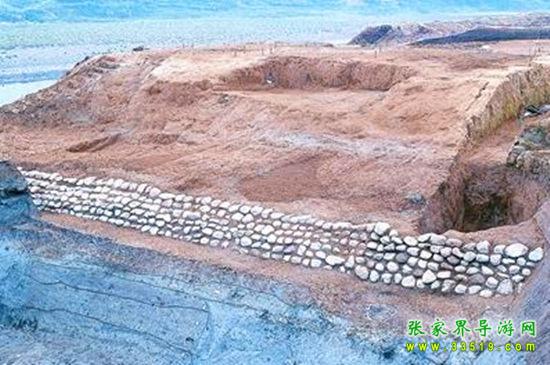
The north city wall and west city wall of the ancient city of Liyi are quite well preserved. The wall is 2 meters high and 24 meters thick at the base. It was built by ramming earth, and the slopes on both sides of the wall were built with large cobblestones. According to archaeological experts' dissection of a 100-meter excavation square at the north city wall, the wall was once built during the Chu and Qin periods. The first construction was a military castle built during the Warring States period, and it gradually took shape through the Qin and Han periods. Outside the ancient city wall there is a moat 6 meters wide and 3 meters deep, forming a defensive layout with both a city and a moat, as solid as metal and stone.
"China's No. 1 Well"
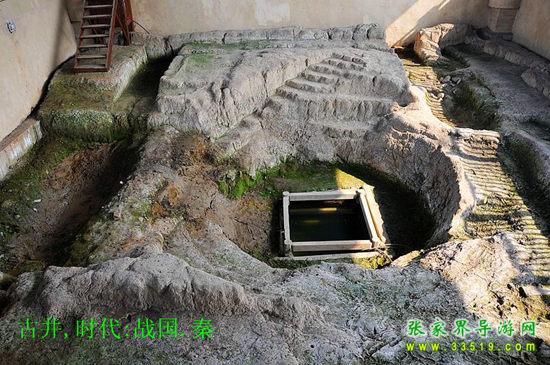
This is Well No. 1 of the ancient city. Because of its peculiar structure and because it sealed more than 30,000 Qin bamboo slips, archaeologists have called it "China's No. 1 Well." The structure of the well is very refined. The diameter of the well ring is about 4.2 to 4.5 meters, the depth reaches 14.28 meters, and the well mouth is 3 meters below the ground surface. It was built by stacking 43 layers of mortise-and-tenon wooden boards. Each board is 2 meters long, 30 centimeters wide, and 15 centimeters thick. They were stacked layer by layer with mortise-and-tenon joints, and the gaps between the wooden frame and the well wall were filled with green clay. The bottom of the well is native cobblestone. A pre-Qin ancient well with such a structure and such depth was the first of its kind seen in our country. From the discovery of the first Qin bamboo slip in the well on June 3, 2002, more than 30,000 Qin bamboo slips, totaling more than 200,000 characters, were found in Well No. 1, 7.5 times the total number of Qin bamboo slips unearthed in China in the twentieth century. Most of the contents are official archives, involving the society, politics, military, economy, culture, and ethnic groups of the time. Most of the bamboo slips date from the 27th to the 37th years of Qin Shi Huang after King Zheng of Qin unified China in his 26th year (Gengchen) (221 BCE to 211 BCE), with not a single year missing, and the records are detailed down to the day and month. They are the richest and most precious original official documents of the Qin dynasty in China. In vivid written form, they fill major gaps in Qin dynasty history, and their massive historical information will independently construct a brand-new historical framework.
Ancient Tomb Groups
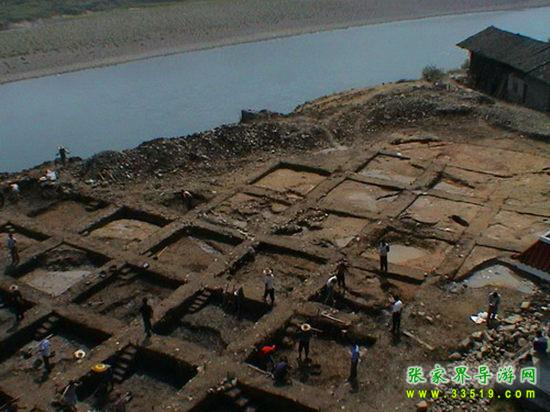
These include the Western Han ancient tomb group at Daban and the Warring States ancient tomb group at Maicha. After the excavation of the Liyi ancient city of the Warring States period, the ruins of a Western Han ancient city and a large-scale Han tomb group were also discovered in Daban Village, Liyi Town. The Han tombs are distributed over an area of more than one square kilometer, with dense tomb chambers and rich burials. The Western Han ancient city at Daban is surrounded by water and mountains, occupying a strategic position, controlling the key route between Chu and Shu, and possessing a majestic air. The Maicha Warring States ancient tomb group is located southeast of Maicha Village, Liyi Town, with a distribution area of about 4 square kilometers. In 1989, 55 tombs were excavated, all earthen pit shaft tombs. Unearthed bronze objects include swords, dagger-axes, seals, mirrors, chime stones, bells, and belt hooks; pottery objects include ding, dui, hu, bo, dou, guan, gui, spinning wheels, as well as glass tube beads, jade bi, broken iron objects, and stone ornaments. Among them, Warring States weapons such as the Ba-style willow-leaf sword are finely cast and incomparably sharp, truly rare treasures of the ages, and have been listed as National First-Class Cultural Relics. These thousands of ancient tombs echo the three ancient cities from afar, forming a complete urban system and providing the most valuable scientific basis for the study of the history of the Warring States, Qin, and Han periods.
Liyi Ancient Street
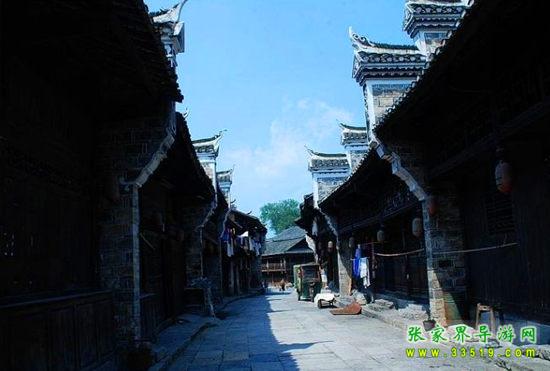
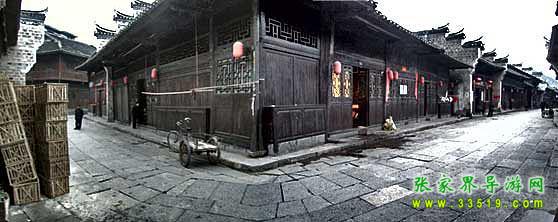
Its history can be traced back to the Warring States and Qin-Han periods, while the present Liyi Ancient Street took shape in the early Qing dynasty. In the Qing dynasty there were already seven streets and ten lanes, including Zhongfu Street, Daoxiang Street, Pijiang Street, Wanshou Street, Jiangxi Street, Sichuan Street, and Deyou Lane. Large and small shops lined the ancient street in close succession, and the shop signs were quite antique. Some used dark-lacquered plaques made of catalpa wood, some used tea-colored hanging panels of nanmu, all with bordered edges and corner mounts, and some used various fabrics as wine banners and tea banners, with inscriptions in gold, green, or vermilion, antique and elegant. The blue stone slab street surface was changed to a triple-soil loach-back street surface. Every street could lead directly to the river wharf. Most of the buildings facing the street were two-section, three-bay wooden houses with a shop in front and living quarters behind. Between each household were wharf-shaped blue-brick fire-sealing walls, and wealthy families even had deep courtyards known as "yinzi houses," commonly called fire-sealed tube houses. Looking along the street, every house had water-carrying eaves, curved look-up boards, shop counters, and display cabinets arranged in good order, with goods from north and south, printed and dyed cloth, and assorted ceramics dazzling the eye. On market days falling on the first and sixth of the month, the place was bustling everywhere, and the cries of vendors in mixed northern and southern accents intertwined with the strong local dialect, forming the prosperous scene of Liyi Ancient Town's trade reaching all directions.
River Wharves
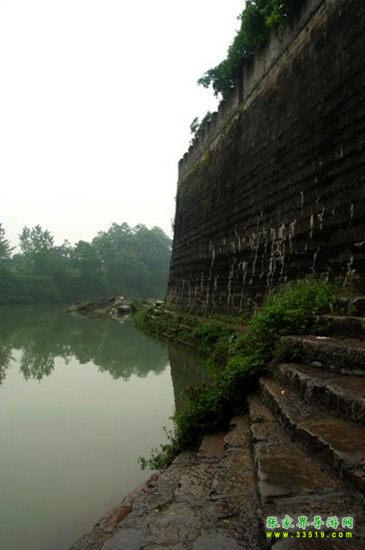
Liyi Ancient Town sits on the north bank of the Youshui River. Along the bank there are three wharves: upper, middle, and lower, among which the middle wharf and lower wharf are the busiest. More than 150 boats moored here every day, mostly black-canopied boats of varying sizes. Large boats were downstream boats, running specially to Changde and Hankou; medium boats went down to Baojing and Yuanling; small boats were upstream boats, running specially to Xiushan and Youyang. More than one hundred black-canopied boats moored along the bank, and the lights on the boats and the thousands of household lights on shore reflected each other, forming a unique scenic line of the ancient port. The north bank consisted entirely of stilted wooden buildings, simple and elegant, antique and charming, with the distinctive style of Tujia ganlan-style architecture. Most of these wooden buildings were inns and taverns, some with singers playing and singing short tunes, some with fishermen's drums and Daoqing storytelling. This scene was just as the Liyi literatus Chen He recited: "Mist shrouds the cold water, moonlight shrouds the sand, lights on the water near ten thousand homes; boatmen love to sing the flower-picking tune, the sound of wood leaves is bright while the qin sound is hoarse."
Ancient Buildings
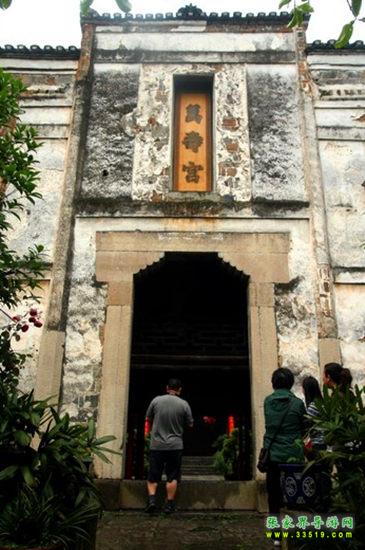
Before the Qing dynasty's replacement of native rule with centrally appointed officials in the Yongzheng period, the indigenous people of Liyi were mainly Tujia. In the Ming dynasty there were already sacrificial buildings such as the Babu Temple (that is, the Tujia Great Hand-Waving Hall), the Popo Temple, and the Tuwang Shrine (that is, the Tujia Small Hand-Waving Hall). After the seventh year of the Yongzheng reign of the Qing dynasty, the prohibition that "Han people shall not enter the territory" was abolished, and large numbers of Han people moved into Liyi to do business. They successively built the Wenchang Pavilion, Yalu Nunnery, Wanshou Palace, Guandi Palace, Shuifu Palace, Qingping Temple, Longyin Temple, and others.
Popo Temple
It was built to commemorate Chongbani, the wife of Xiang Laoguanren, an ancient leader of the Tujia people. The Popo Temple was built facing the Youshui River in Liyi Town. In front of the temple are ancient trees with swaying branches, no less than four hundred years old. Its architecture is extremely exquisite, and its stone carvings and painted sculptures show great ingenuity. It is the most completely preserved sacrificial site of maternal worship in the Tujia region of China. Whether in terms of sacrificial culture or architectural craftsmanship, it has its own unique value.
Wenchang Pavilion
Located in Liyi Town, it was built in the tenth year of the Yongzheng reign of the Qing dynasty (1732) and covers four mu. It was a place for honoring Confucius and promoting culture and for holding sacrificial ceremonies. Vermilion hall pillars paired with green glazed tile roofs make it appear magnificent and solemn; on the upturned eaves with ao-fish ornaments hang eighteen wind chimes, and when the clear breeze comes gently, they tinkle audibly and can be heard from near and far.
Guandi Palace
Located on the north bank of the Youshui River in Liyi Town, it covers more than three mu. In addition to the Guandi Shrine and Lingguan Hall, it also has a spacious and tall theater building. On the palace gate, the four gilded characters "Heaven and Earth Share the Same Flow" are inscribed in vigorous and flowing calligraphy, and the stone lions in front of the gate are spirited and imposing. Every night the theater was filled with spectators, and the ancient temple theater stage performed all the joys and sorrows of the ages.
Yalu Nunnery
Located on Yalu Mountain behind Liyi Town, the quiet mountain and secluded woods make the birdsong and floral fragrance all the more evident. Hu Jinchun, a bagong scholar of the late Qing dynasty, wrote "Climbing Yalu Mountain" in praise: "Finding leisure, I join companions and climb up, staying briefly in the meditation room where all sounds are clear; most of all in the deep and shallow places of green shade, the cuckoo lets out just two or three notes." The ancient nunnery is elegant and graceful, ethereal and small, filled with poetic charm everywhere.
Transportation
You can take a long-distance bus directly from the South Bus Station in Jishou City. Buses are available from 7:15 to 14:00, and the journey takes more than 4 hours. You can also first take a bus from Jishou City to Longshan County, then take a tourist shuttle bus from the Longshan County Bus Station to Liyi.