This attraction introduction is compiled from historical materials in the "Zhangjiajie Tour Guide Network" (33519.com · Scenic Spots section). Ticket prices, opening hours, transportation, and contact information mentioned in the text may be outdated. Please refer to the latest official announcements from the scenic area before traveling; some content consists of historical background/cultural introductions and is for reference only.
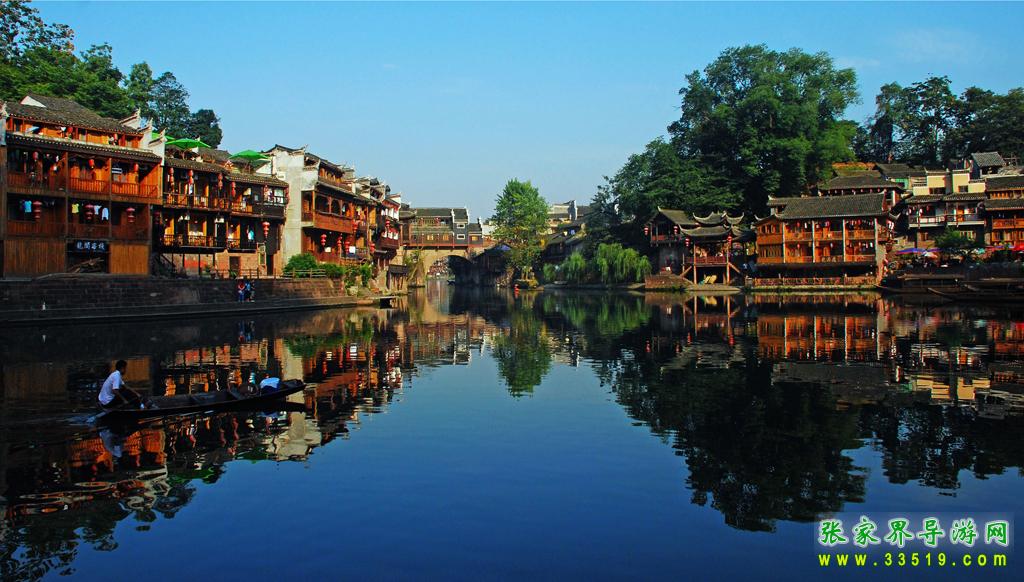
Pushi Town is located 35 kilometers southeast of Luxi County, Hunan Province, on the west bank of the middle reaches of the Yuan River. To the east it faces Fangtian Township of Chenxi County across the river, to the south it borders Changping Township, to the west it connects with Dalang Town and Baiyangxi Township, and to the north it links with Lijiatian Township. Within a 20-kilometer radius of Pushi, streams crisscross and the terrain is flat; the climate is mild and the soil fertile; transportation is convenient and commerce prosperous. Pushi Town is a famous historical and cultural town in China and one of the three great ancient towns of Xiangxi. Pushi Town has a long history and culture. Because of its developed water transportation, Pushi's commerce and culture were extremely prosperous in history. Pushi is an important distribution center for materials in the middle reaches of the Yuan River. Agricultural and sideline products such as water chestnuts, garlic, lotus roots, and sweet oranges are sold far beyond the province to various places.
The town was established in November 1949, covering an area of 143.5 square kilometers with a population of 39,000, of which the urban area is 2.5 square kilometers with an urban population of 16,000. It administers 92 county and town direct organs, factories, mines, enterprises, and institutions, as well as 4 neighborhood committees—Cross Street, Taiping Street, Xinjian Street, and Yanfang Street—and 22 village committees including Yinjiaqiao, Chengxiang, Huangjiaqiao, Puxi, Xiao'anping, Gaoqiao, Qingcao, Yinjingchong, Xinbao, Duqi, Tianjiaxi, Gaoshanping, Huidong'ao, Yuping, Xiaoma, Yanmenxi, Leigupo, Wuguoliu, Maojiatan, Maxikou, TiezhuTan, and Niujiawan Citrus Farm. In 2010, it was awarded the honorary title of the fifth batch of 'Chinese Historical and Cultural Towns' by the Ministry of Housing and Urban-Rural Development and the National Cultural Heritage Administration.
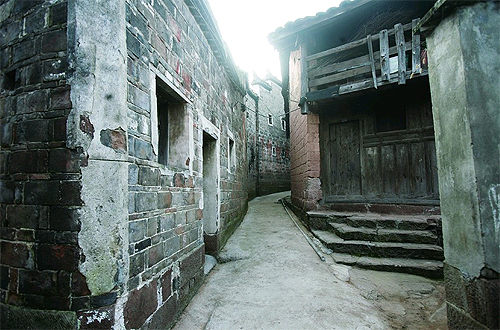
Due to well-developed water transportation, Pushi's commerce and culture were extremely prosperous in history. From the Ming and Qing dynasties to the Republic of China period, in this ancient town of less than two square kilometers, three ancient commercial streets, six ancient opera towers, thirteen provincial guild halls, over twenty cargo wharves, forty-five alleys, more than fifty fire-sealed walled courtyard houses, seventy-two temples and Taoist monasteries, and over ninety workshops were built. Because of commercial exchange and cultural integration, it earned the reputation of 'Little Nanjing.'
Pushi Town has a long history, and the ancient town's culture runs deep. Its main cultural relics and historic sites include Pushi Old Street, Wanshou Palace, the Ji Family Ancestral Hall, a Neolithic site, the Zhou Family Compound, Tianwang Xinggong (Heavenly King Temporary Palace), and Jiangdong Ancient Temple.
The Guanlan Academy in Pushi was a cradle for cultivating talent. In the twelfth year of the Jiaqing reign of the Qing Dynasty (1807), Fu Ding, the Daoyin of the Chen-Yuan-Yong-Jing Military Defense Circuit, established an academy there and allocated 420 shi of grain from the military farming fields as stipends for teachers and students. The academy was initially named 'Puyang Academy,' with teachers and students lodging at Wenchang Pavilion (now Pushi Hospital). It was not until the eighteenth year of Jiaqing (1813) that the academy was formally built at Dading Gate (now Pushi Central Primary School). After the former observer (i.e., Daotai) Yao Jiqing examined the 'Luxi County Annals' and found that there was a Guanlan Pavilion 50 li southwest of Wuxi in Pushi, it was renamed 'Guanlan Academy.'
The 'Four Books and Five Classics' were the main textbooks, and classes were conducted in a large lecture hall. The main lecturers were mostly the mountain chief, and sometimes outstanding students also took the podium to teach.
In the twenty-ninth year of the Guangxu reign of the Qing Dynasty (1903), the imperial examination system was abolished and schools were established, and it was changed to the 'Official Higher Primary School.'
The school's motto was 'Benevolence,' 'Sense of Shame,' and 'Loyalty and Bravery.'
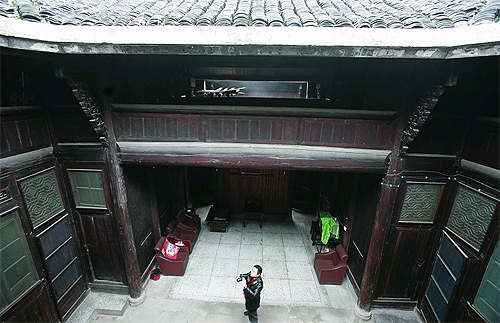
Against the backdrop of convenient transportation, gathering merchants, and accumulating wealth, the tall, imposing, and fully functional Pushi residences gradually matured and became refined. The Ji Family Compound represents the overall standard of Pushi residences. It is said that the Ji family ancestors traveled from Shanxi to western Hunan to do business, starting out by selling tung oil and timber, and accumulated great wealth.
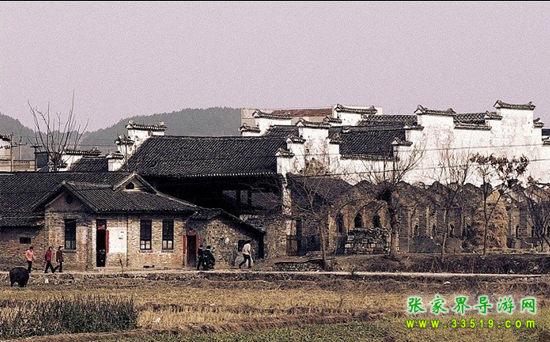
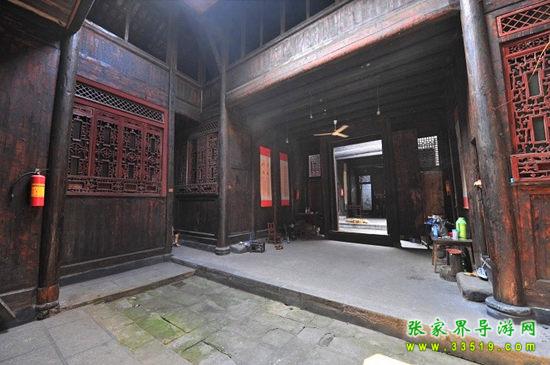
Overall, the residential buildings in Pushi all follow the structural pattern of 'shop in front, residence in back.' The Ji Family Compound is built of brick and wood, with a depth of 58 meters, and the interior consists of 'three wells, three halls, and twelve rooms.' The surrounding fire walls are over ten zhang high, providing both fire protection and wind resistance. The front facade is a three-story connected structure, all built with stone slabs. The door lintel features high-relief carvings of auspicious phrases such as 'Family Rules and Pure Breeze,' with lotus flowers and fragrant grass carved at both ends, and geometric patterns decorating the surroundings. The window carvings are mainly geometric patterns, with carvings of the Eight Immortals, figures, flowers and plants, and fighting scenes in the center. All the carvings are meticulously detailed and lifelike.
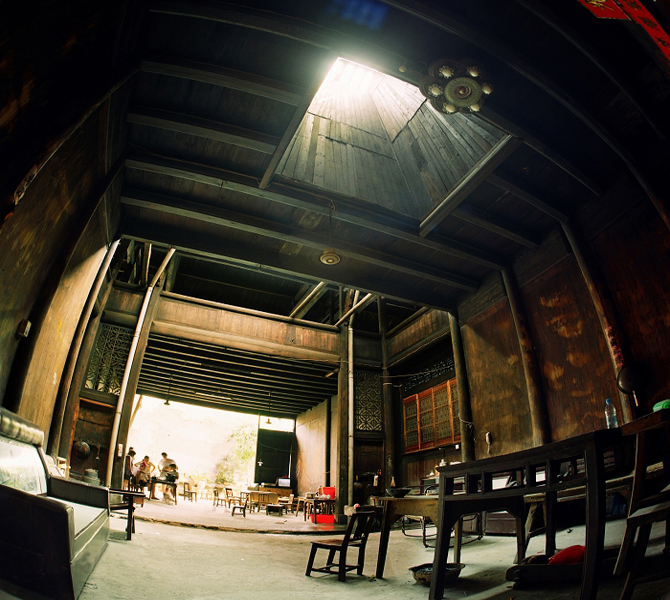
The side rooms within the compound were occupied according to the seniority of family members. The wooden windows of the side rooms are carved with dragons and phoenixes, and each panel carving tells a beautiful legend. Among them, carvings such as "Liang Shanbo and Zhu Yingtai," "The Heavenly Match," "Clam Shell Lantern," "Painted Dragon Boat," "Mouse Stealing Grapes," and "Eagle Catching Chicken" are especially vivid and remarkably true to life. The upper floors were mainly used for storing goods, keeping miscellaneous items, and drying clothes. At the rear were the kitchen and toilet facilities, and at the back of the compound was a garden, at the far end of which was a private wharf connected directly to the river.
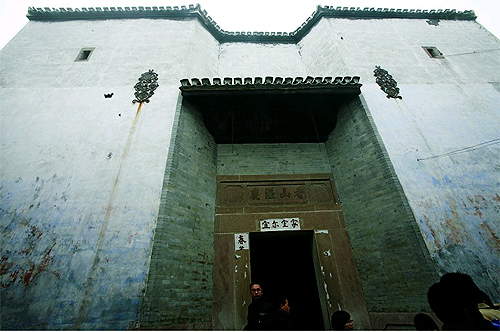
The Pushi folk dwellings possess extremely high research value. The architectural layout of "shop in front, residence behind" is rarely seen, especially in that on the threshold of the second entrance, every building has a dog hole, reflecting the historical representation of local folk dog worship and providing physical evidence for the study of Panhu culture. "I have seen many Hunan folk dwellings, and compared with northern folk dwellings, I often felt a sense of inferiority. But after seeing the Ji Family Compound this time, I can finally straighten my back and say that our Hunan folk dwellings are by no means inferior to those of the north. Their exquisiteness is comparable to the 'Qiao Family Compound,' and they fully qualify for application as a provincial-level cultural relic protection unit. The Ji Family Compound is the most exquisitely designed and best-preserved Ming and Qing dynasty grand residence discovered in our province to date."